
Suffolk County Criminal Court Cases
Suffolk County criminal court cases do not all go to one records counter. County Court handles felony prosecutions. Its Criminal Office is on the second floor of the Arthur M. Cromarty Criminal Court Complex at 210 Center Drive in Riverhead. District Court serves Babylon, Brookhaven, Huntington, Islip, and Smithtown. It handles misdemeanors and lesser offenses, as well as felony arraignments and early felony proceedings. Town and village justice courts keep local files within their own jurisdictions, a key point for cases from the East End.
The filing path can change during one Suffolk County case. A felony may begin in a local criminal court, then move to County Court after a grand jury returns an indictment or the defendant proceeds by superior-court information. The Suffolk County Clerk is clerk of Supreme and County Court and maintains felony-level Criminal Court Actions files. Misdemeanors and violations remain with District Court or the responsible justice court. An arrest report or jail entry is not the court case file because it does not track the later plea, motions, disposition, or sentence.
Suffolk County Court Venue Split
The county has two main courthouse hubs. The First District Court Criminal Term at the John P. Cohalan Jr. Court Complex, 400 Carleton Avenue in Central Islip, has public criminal windows on the second floor from 8:30 a.m. to 4:30 p.m. on weekdays. Its criminal clerk can be reached at 631-208-5800. Start there for a pending District Court date or a lower-court certificate of disposition.
Riverhead is the felony-record hub. The County Court Criminal Office handles files about three years old or newer at 210 Center Drive and lists 631-852-1461 and SCCC@nycourts.gov. Older felony files move to the Suffolk County Clerk at 310 Center Drive, whose main number is 631-852-2000. That three-year split can send a sound request to the wrong office if the case age is not stated. A District Court search miss also does not rule out a town or village court matter outside the western district system.
District Court Criminal Term
400 Carleton Avenue
Central Islip, NY 11722
631-208-5800
Weekdays, 8:30 a.m. to 4:30 p.m.
County Clerk Criminal Actions
310 Center Drive
Riverhead, NY 11901
631-852-2000
Felony archive and certified records
Searching Suffolk County Case Records
Use the court and case stage to choose a channel. WebCrims Defendant Search is free and best for a public pending matter with a future appearance. Calendar Search works when the court, date range, part, or judge is known. The Suffolk County Clerk Court Minutes kiosk is an index lead for felony papers, not a replacement for the unsealed file. Clerk contact remains vital for closed cases, certified copies, and a search that does not return the expected matter.
- Identify whether the Suffolk County matter is a felony, District Court case, or town or village court case.
- Search WebCrims by defendant name or use the full case identifier, preserving hyphens, leading zeroes, and trailing letters.
- Filter by Suffolk and the likely court, then compare the court, docket, date, and part before treating a name match as relevant.
- Open the case detail to read charges, appearances, and motions, or use Calendar Search for a future court session.
- Contact the holding clerk for the full unsealed file, a certified disposition, an older felony archive, or a completed matter.
| Field label | Type | Required | Suffolk search note |
|---|---|---|---|
| Defendant last name | Text | Yes for name path | Local guidance calls for at least the first three letters |
| Defendant first name | Text | Yes for name path | Local guidance calls for at least the first two letters |
| Middle initial | Text | No | Useful for narrowing a common name |
| County or court | Dropdown | No | Select Suffolk or the known criminal court |
| Case number | Text | Yes for case path | A District Court form may look like CR-######-YYSU |
Reading Suffolk County WebCrims Results
The official WebCrims defendant form shows why exact search fields matter before a Suffolk County court record can be opened.
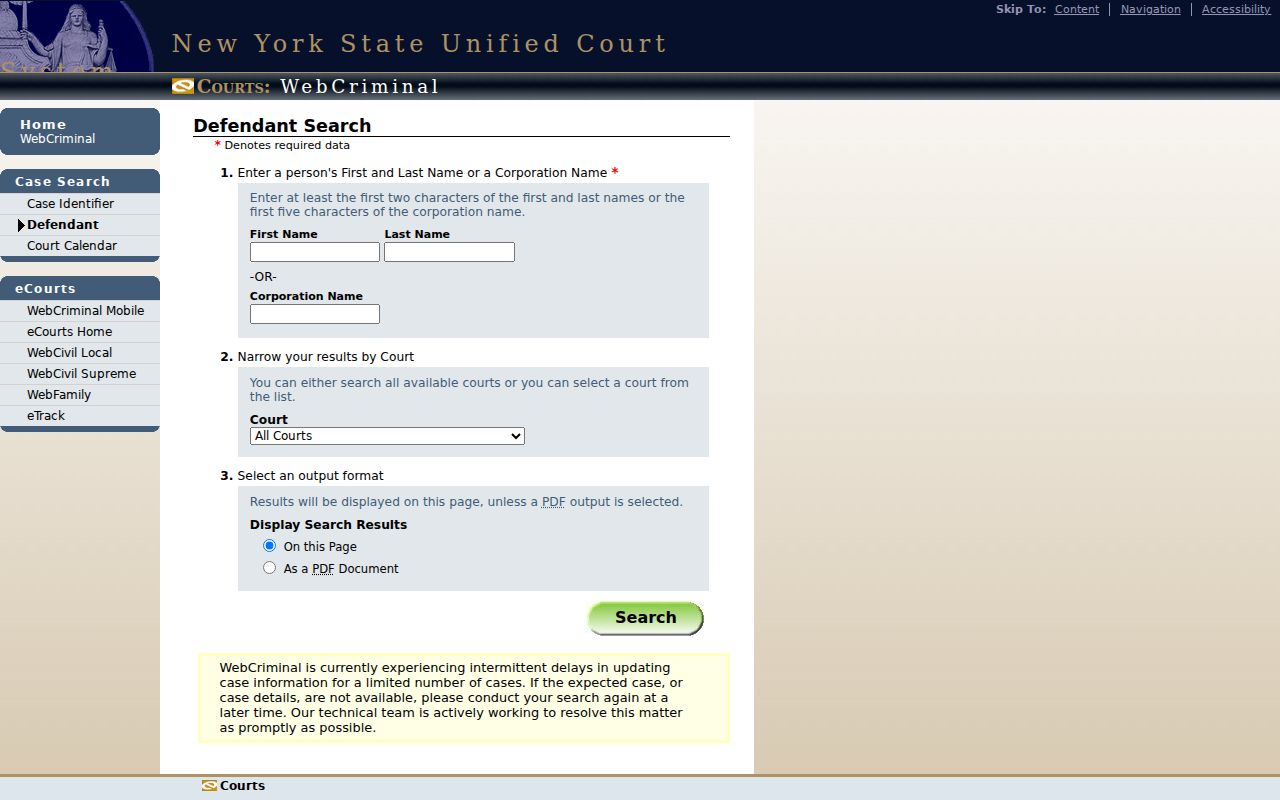
The resulting summary can identify the display name, case or summons number, next court, next date, and part. County or Supreme Court matters may also show the judge. Case detail can add a birth year, incident or arrest dates, related case numbers, charge status, recorded appearances, motions, counsel, prosecutor, and arresting officer when those fields are available.
A blank result has strict limits. WebCrims updates daily, yet a new Suffolk County case can take more than a day to appear. The service leaves out completed cases, warrants, sealed cases, eligible youthful-offender matters, and other records excluded by law. Check spelling and the full docket first. Then call the likely clerk. A same-name result is also not identity proof, so compare the middle initial, court, case number, and known dates without seeking protected identifiers.
Inside a Suffolk County Case File
The court file follows allegations after they become filed charges. It can show what the prosecutor placed before the court, what occurred at each appearance, and how each count ended. That scope is much wider than a booking record. Suffolk County clerks may keep paper, scanned, or electronic material, and the public screen exposes only part of the file. Grand-jury proceedings, sealed material, protected personal data, and confidential records do not become public merely because other docket entries can be viewed.
| Case number and court | Identifies the docket, court, part, and often the assigned judge |
|---|---|
| Charging document | Shows the complaint, information, indictment, or superior-court information and filed counts |
| Docket entries | Tracks filed papers, orders, motions, and other recorded activity |
| Appearances | Lists scheduled or recorded dates, parts, and event information |
| Disposition | Records dismissal, acquittal, plea, conviction, or another outcome by count |
| Sentence | States the judgment and any recorded custody, probation, fine, restitution, or court conditions |
The certificate of disposition is the court-certified summary of how one case ended. It is often the best record to resolve a missing or wrong outcome on a person’s own New York State Division of Criminal Justice Services record.
Suffolk County File Archives
The County Clerk’s Criminal Court Actions description confirms that its Suffolk County role centers on felony indictments and superior-court informations.
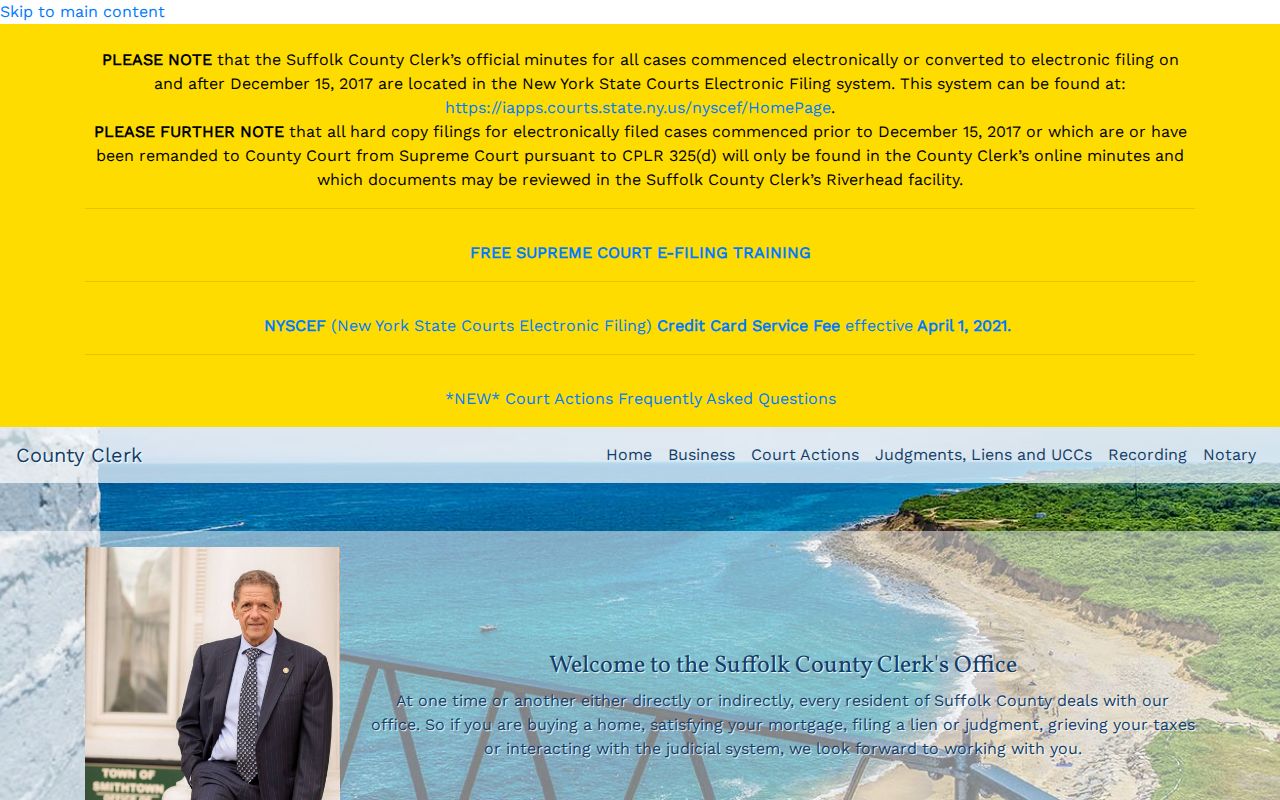
The clerk redirects misdemeanor and violation requests to District Court or the court that heard the matter. For a felony certificate, supply the defendant name and indictment or superior-court-information number. County Court lists a $5 charge and accepts in-person or mailed requests. A mailed request needs a return address and a postal money order or bank check payable to Suffolk County Court. The stated estimate is seven to ten business days.
For transcripts, call 631-852-2151 with the name, indictment or SCI number, part, judge, and date. Court Minutes index numbers use a two-digit year, a space, and five or six digits with leading zeroes, such as 20 00123. Treat an index result as the way into the record, then ask the clerk about inspection, copies, or certification. Newer electronic matters may also be in NYSCEF, but that does not change which clerk owns the Suffolk County file.
How a Criminal Case Moves
A Suffolk County criminal case begins when charges are filed in the arraigning court. At arraignment, the court addresses the accusatory instrument, counsel, a plea, release or bail where allowed, and a return date. Pretrial work can include discovery, conferences, motions, hearings, and plea talks. A felony may shift from local criminal court to County Court after indictment or superior-court information. A misdemeanor usually stays in District Court or the responsible justice court.
Case flow: Charges Filed › Arraignment › Pretrial › Plea or Trial › Disposition › Sentencing
The last court event is not the last record step. The court or criminal-justice agency reports the disposition to DCJS so it can close the matched fingerprint arrest cycle. If a Personal Record Review says “no disposition reported,” obtain a certified Suffolk County disposition and follow the DCJS challenge instructions. That phrase does not prove the prosecution is still open.
Suffolk County Docket Terms
Short labels can point to very different Suffolk County file paths. Read the instrument and result, not just the original charge. A booking allegation can change through prosecutor review, indictment, plea, trial, or dismissal. These terms help distinguish the most common case milestones.
- Indictment
- A grand-jury accusation that commonly leads to the felony file held in County Court and the County Clerk archive.
- SCI
- A superior-court information, which is a felony charging instrument used in the process allowed by New York law.
- Arraignment
- The appearance where the court addresses charges, rights, counsel, a plea, and the next date.
- Disposition
- The recorded outcome of a count or case, such as dismissal, acquittal, plea, or conviction.
- Certificate of disposition
- The clerk-certified summary of the outcome in one criminal case.
District Court case numbers may use the local CR-######-YYSU pattern. WebCrims guidance says to retain hyphens, leading zeroes, trailing letters, and an SCI prefix when it is part of the identifier.
Suffolk County Specialty Court Records
Some Suffolk County criminal court cases follow named treatment or problem-solving paths. Veterans Court sits in Courtroom D-33 at 400 Carleton Avenue and lists 631-208-5775. Judicial Diversion serves eligible drug-dependent felony defendants through treatment and supervision. Mental Health Court considers eligible cases in which mental illness contributed. East End Regional Intervention Court serves Riverhead and Southampton Town Courts.
These programs do not create a separate public background-check database. The responsible court still keeps the docket and disposition, while program material can be limited by confidentiality rules or a sealing order. Admission depends on court and program criteria. When a public docket refers to a specialty part, use that detail to identify the clerk and next appearance, not to infer facts that the public file does not state.
Case Record Access & Restrictions
New York court records follow clerk and court-access rules, not the county executive-agency FOIL process. Judiciary Law §255 directs clerks to search and certify records in their custody when lawful fees are paid. For an unsealed pending Suffolk County case, start with WebCrims. For a completed felony, use County Court or the County Clerk based on age. Seek a lower-court disposition from District Court or the town or village court that handled it. OCA’s statewide Criminal History Record Search is another public court-record channel, but its $95 exact-name-and-date-of-birth result is not certified and excludes sealed and other covered-out records.
Sealing narrows public access on purpose. CPL 160.50 generally seals favorable terminations, while CPL 160.57 creates Clean Slate automatic sealing for eligible records under its terms. Youthful-offender matters, juvenile records, grand-jury material, protected victim data, and personal identifiers also face limits. The public copy may contain redactions even when the clerk holds a fuller official file.
For one’s own statewide fingerprint history, use DCJS Personal Record Review through IdentoGO. DCJS does not provide a public name database. If the repository record lacks a Suffolk County outcome, the certified disposition from the holding court is the sound proof for a challenge.